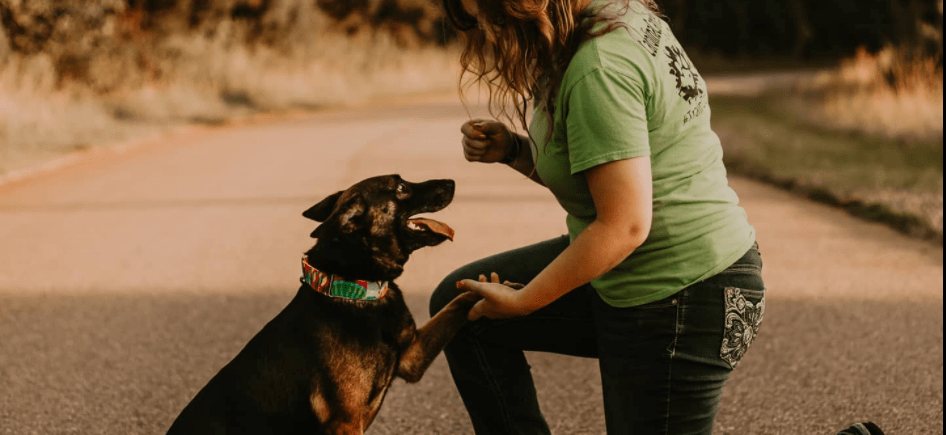
We Teach using Positive Reinforcement based training. This means we reward good behaviors and teach dogs what we want them to do. You can not punish negative behaviors, when you haven’t taught the expected behavior. Does this mean there are no consequences? Absolutely NOT! However, instead of physical or corporal responses, we teach natural consequences. This builds your bond with your dog instead of instilling fear of a punishment.
Yes, we use treats – when you look at food as Dog Currency instead of a taboo crutch, dog training becomes much more simple! You work for cash and checks, they work for food and toys! Do you need a dollar bill taped to your desk to remind you to work? Doubtful – you work with the understanding that the paycheck is coming. Toddlers, on the other hand, need more instant gratification in their reward systems. Dog Training works much the same, in the beginning we use instant gratification with a treat – as we progress they work with the understanding that food is coming. Marker Training to teach new skills – this is based on operant conditioning. Dog Does Behavior We Want -> We MARK the behavior with a word or sound (like a clicker) and then they get a reward. The system uses conditioned reinforces which are able to be delivered more quickly and more precisely than primary reinforces, such as food. The Primary reinforcer (Treat or toy) comes a set noise or sound.
The Koehler Method for behavior modification – this is based in the philosophy that a dog acts on its right to choose its actions. A dog’s learned behavior is an act of choice based on its own learning experience. When those choices are influenced by the expectation of reward, the behavior will most likely be repeated, and when those choices are influenced by the anticipation of punishment, they will most likely cease. *Punishment DOES NOT mean physical discipline! Most of the time, punishment is simply removing the dog from the scenario / reward item or placing them in Time Out
What is a Consequence? A dog is taught using 100% Positive Reinforcement – adding something good (treats, pets, attention, playtime, etc) to encourage a behavior to happen again. But we also use the other 3 Quadrants of Conditioning to influence if a certain behavior happens again. Reinforcement encourages a dog to make a choice again – Consequences are corrections that only happen AFTER a dog has learned an expected behavior and discourage a dog from making that choice again.
Example – a Dog Wants to Greet a new People on their walk- We have taught the Dog that they must Sit and Wait for a release before getting to greet the new person. While meeting that person, they must keep all 4 paws on the ground, not touch the person with teeth and not push into the person in a way that would kock them over. We taught ALL of this in small steps, using Positive Reinforcement. But what happens when they choose to not do these expected behaviors?
Positive Reinforcement – ADD Good Thing-> Behavior Increases Dog Sits and waits as expected – ADD Greeting of Person-> Dog makes this choice more often
Positive Consequence – ADD Bad Thing -> Behavior Decreases Dog Pulls to see person – ADD Distance between Dog & Person-> Dog Pulls to People less often
Negative Reinforcement – REMOVE Bad Thing -> Behavior Increases Dog waits for permission to meet people – REMOVE time dog has to wait before meeting person-> Dog offers sit and wait for permission behavior more often and quicker
Negative Consequence – Remove Good Thing -> Behavior Decreases Dog Jumps on New Person – REMOVE Opportunity to Greet new People -> Dog Jumps less often
Every dog is different and we utilize a variety of training styles, dependent on the dog in front of us – did you know there are SIX ways to teach a dog to lie down – without using force? Building a training relationship allows you to work with a dog who WANTS to work with you!
What We Don’t Use
X Dominance Based Training – this is a model based on a theory that “dogs are wolves” and since wolves live in hierarchical packs where an alpha male rules over everyone else, then humans must dominate dogs in order to modify their behavior. You may recognize this method form popular TV Reality shows where the “trainer” alpha rolls the dog by laying on the dog until the dog “submits”.
This method can suppress behaviors without addressing the underlying cause of the problem and increase or cause a dog’s fear, anxiety and aggression. This method is often referred to as “Old School” Training.
X Compulsion Training Tools and Methods – this includes but is not limited to E-collars, Prong Collars, Choke Chains, Spanking, Nose Popping, Leash Yanking, Scolding, Yelling, Forceful Maneuvering or any other action or tool that may instill fear.
This method can also suppress behaviors without addressing the underlying cause of the problem and increase or cause a dog’s fear, anxiety and aggression. We also prefer to use natural consequences instead of relying on a tool to communicate for you. Fearful Dogs may be compliant, but they are not enjoying life with you if they are scared of you.

 Big To Small, We Train Them All